
Nov 06, 2024
By
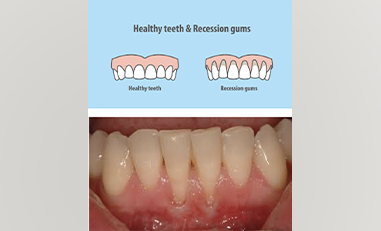
Gum recession/ Gingival recession occurs when the margin of the gums surrounding the teeth wears away or pulls back, exposing surfaces of the tooth or the tooth’s root.
Receding gums become a health concern, leaving the teeth at risk of decay, infection, and loss.
Symptoms
some people with receding gums may have no concerns about/ might not be aware that their gums are receding.
However, some individuals with receding gums may experience the following:
- the teeth appear longer and increase of spacing between the teeth.
- sensitivity to cold and heat
- Bleeding gums when you brush
- Swollen painful gums
- Bad breath
- Changes in your bite or the way your teeth fit together.
Various preventive measures can be taken during hygiene visits and at home for patients experiencing dentinal hypersensitivity associated to gingival recession.
When gingival recession occurs, disease-causing bacteria start to form as gaps and pockets between the teeth and the gingival lining appear.3,4 If left untreated, supporting tissue and bone structures of the teeth can be severely damaged, ultimately resulting in tooth loss.4
What causes gingival recession?
Gingival recession is multifactorial. Its causes include:
- Gingival /Periodontal disease
- Supragingival and subgingival calculus accumulation
- Aggressive toothbrushing and use of a hard-bristled toothbrush
- Improper flossing
- High frenal attachment (which may impede plaque removal by causing pull on gingival margins)
- Tooth movement by orthodontic forces.
- Improperly designed dentures and restorations.
Can I prevent gum recession?
Gum recession can’t always be prevented, especially if you are genetically predisposed to thin gum tissue. However, you can significantly reduce your risk of infection-related gum recession by practicing proper oral care which includes
- Brush your teeth thoroughly twice every day.
- Floss once daily.
- Use an antimicrobial mouthwash twice daily.
- Follow your dentist’s recommendation for teeth cleanings.
- Use a soft-bristled toothbrush.
- Don’t smoke or use chewing tobacco.
See your dentist if you notice any signs of gum recession.
Management and Treatment
Unfortunately, receding gums can’t grow back. But you can take steps to prevent gum recession from worsening.
How can I reduce sensitivity caused by gum recession?
Many people with gum recession experience pain or sensitivity. This is because your tooth roots aren’t covered with protective enamel. They’re covered with cementum, which isn’t as strong.
One of the most common causes of gum recession is faulty brushing habits which can harm gingival tissues due to brushing pressure and bristle type. Dentinal hypersensitivity is an issue for many patients who use hard-bristled toothbrush. Patients are advised to use a soft- or ultrasoft-bristled toothbrushes and gentle brushing.
Also, patients should consider a toothpaste with ingredients that reduce tooth hypersensitivity like calcium sodium phosphosilicate, arginine and calcium carbonate, strontium, or potassium nitrate. These ingredients depolarize the nerves or block dentinal tubules to prevent fluid movement, thereby decreasing nerve conduction and dentinal hypersensitivity. Since sensitivity-relief toothpastes work by different mechanisms, patients may need to try several different toothpastes and use them for a few weeks to find the one that alleviates their symptoms. Toothpaste with a high-fluoride concentration may also be beneficial. Desensitizing toothpaste is best when used long term, and it can take several weeks to start working.
Treatment Modalities
Gum recession treatment largely depends on what caused the condition. Mild cases of gum recession may be improved with nonsurgical treatments, such as topical antibiotics, dental bonding or orthodontics. In most instances, however, gum recession surgery is needed to fully correct the problem.
Nonsurgical treatments
Nonsurgical treatments for gum recession may include:
- Scaling and root planing (deep dental cleaning) can be done under local local anesthesia to get rid of harmful bacteria that cause gum disease that are deep under the gum line.
- Laser desensitization- application of lasers in the affected area have proven to be effective in reducing or eliminating teeth hypersensitivity.
- Application of dental bonding agents: Sometimes your dentist can camouflage the area of recession with tooth-colored composite resin. This covers your exposed tooth root, making it less noticeable and more comfortable.
- Orthodontic treatment: If a tooth is crooked, tipped or rotated, it can cause gum recession. In these cases, orthodontic correction is needed.Once the tooth is moved into proper alignment, the gum margin may correct itself over time.
Surgical methods
Gum graft surgery is the most predictable and long-lasting treatment option for gum recession. Typically, a periodontist (gum specialist) performs this procedure.
During this surgery, a gum graft is used to replace your missing gum tissue. The graft usually is taken from the roof of your mouth but occasionally can come from sterilized human donor tissue.
Once the gum graft is in the proper position, your surgeon stitches it into place. There are several different types of gum grafting procedures.
